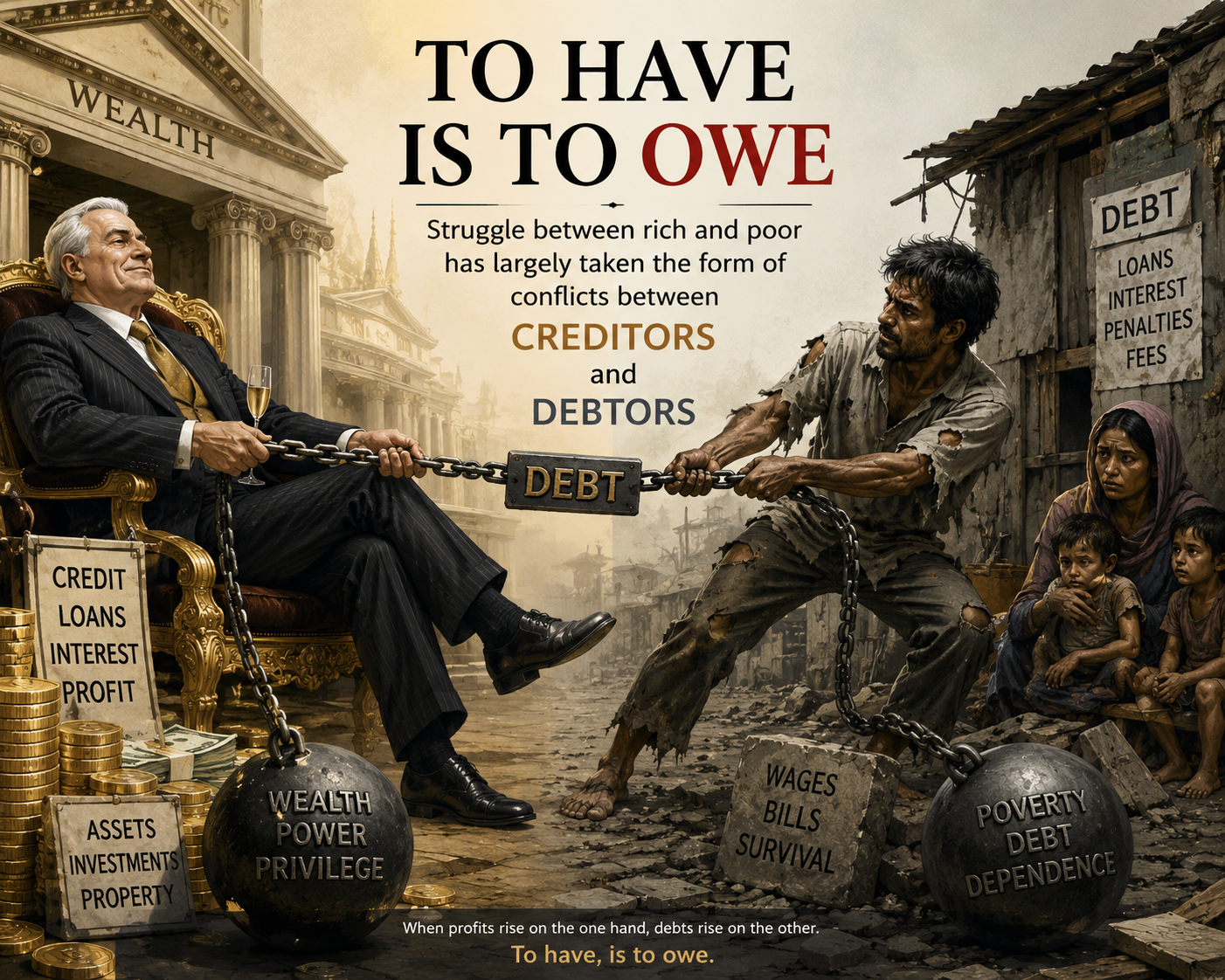
For thousands of years, the struggle between rich and poor has largely taken the form of conflicts between creditors and debtors—of arguments about the rights and wrongs of interest payments, debt peonage, amnesty, repossession, restitution, the sequestering of sheep, the seiz- ing of vineyards, and the selling of debtors’ children into slavery. By the same token, for the past five thousand years, with remarkable regularity, popular insurrections have begun the same way: with the ritual destruction of debt records—tablets, papyri, ledgers;
whatever form they might have taken in any particular time and place. In the throes of the recent economic crisis, with the very defining institutions of capitalism crumbling, surveys showed that an overwhelming ma- jority of Americans felt that the country’s banks should not be rescued—whatever the economic consequences—but that ordinary citizens stuck with bad mortgages should be bailed out. This is quite extraordinary, as Americans have, since colonial days, been the population least sympa- thetic to debtors. (Back then, the ears of an insolvent debtor would often be nailed to a post.) The notion of morality as a matter of paying one’s debts runs deeper in the United States than in almost any other country, which is odd, since America was settled largely by absconding debtors. Despite the fact that the Constitution specifically charged the new government with creating a bankruptcy law in 1787, all attempts to do so were rejected on “moral grounds” until 1898, by which time almost all other Western states had adopted one. The change was epochal.
Those charged with moderating political debate in our media and legislatures have decided that this is not the time for another such change. The US government effectively put a three-trillion- dollar band-aid over the problem, changing nothing. Financiers were “bailed out with taxpayer money”—in other words, their imaginary money was treated as if it were real—while mortgage holders were mostly left to the tender mercy of the courts, subjected to a bankruptcy law that, the previous year, Congress had made far more exacting against debtors. We have even seen a backlash against small-scale debtors, one driven by financial corporations that have now turned to the same government that bailed them out to apply the full force of the law against ordinary citizens in financial trouble. “It’s not a crime to owe money,” reports the Minneapolis Star-Tribune. “But people are routinely being thrown in jail for failing to pay debts.” In Minnesota, “the use of arrest warrants against debtors has jumped 60 percent over the past four years, with 845 cases in 2009. In Illinois and southwest Indiana, some judges jail debtors for missing court-ordered debt payments. In extreme cases, people stay in jail until they raise a minimum payment. In January [2010], a judge sentenced a Kenney, Ill., man ‘to indefinite incarceration’ until he came up with $300 toward a lumber yard debt.”
Despite all this, we hardly know what debt is. The very flexibility of the concept is the basis of its power, and of the moral confusion associated with it. Looking at the history of debt worldwide, one finds that most people have held that paying back money one has borrowed is a simple matter of morality and, contradictorily, that anyone in the habit of lending money is evil. Recently, the former position seems to have trumped the latter, owing to a persistent refusal to question our slavish devotion to creditors. But if the welfare state must be destroyed in order, ostensibly, to settle our debts, we should ask ourselves: To whom, exactly, are those debts owed? And where did our creditors get the money that was loaned to us? (The answer, of course: We owe the very financial institutions we recently bailed out for making fraudulent and idiotic loans; they didn’t get the money anywhere, they just made it up.) Whenever such questions have been openly asked in Europe, riots have tended to ensue.
Such eruptions make it clear that debt must be removed from that rarefied sphere of morality arbitrated by transnational institutions (whose representatives are also its main beneficiaries), where it has become ensconced, and returned to the sphere of open political debate. In the ancient world, it was not debt that was considered sacred, but rather the power to make it disappear. We are, it seems, long overdue for a contemporary Jubilee, one that would affect consumer debt as well as international debt, and that would not only relieve a great amount of human suffering but also remind us that money is not ineffable, that paying one’s debt is not the essence of morality, that borrowing and lending are human arrangements, and that if democracy is to mean anything, it is the ability to all agree to arrange things differently.
It is significant that, since Hammurabi, great imperial states have invariably resisted this kind of politics. Athens and Rome established the paradigm: Even when confronted with continual debt crises, they insisted on legislating around the edges, softening the impact; they eliminated obvious abuses like debt slavery and used the spoils of empire to throw all sorts of extra benefits at their poorer citizens (who, after all, provided the rank and file of their armies) so as to keep them afloat. They did all this in such a way as to fend off any challenge to the principle of debt itself. The US has taken a remarkably similar approach: eliminating the worst abuses (e.g., debtors’ prisons), using the fruits of empire to provide subsidies, visible and otherwise, and, recently, manipulating currency rates to flood the country with cheap goods from China. Never has the governing class allowed anyone to question the sacred principle that we all must pay our debts. That principle has recently been exposed to be a flagrant lie. As it turns out, we all don’t have to pay our debts. Only some of us do.